Questions
Your Questions, Answered
Worktops · Materials · Care · London
Worktops · Materials · Care · London
These are the questions our team is asked most often. If yours is not here, call us on +44 (0)208 361 7818 and we will answer it properly.
It depends on how the kitchen is used. Quartzite and granite are the hardest wearing natural stones and tolerate daily use with little thought. Marble is the most beautiful and the most demanding, because acid etches it. Porcelain and engineered quartz give a completely consistent surface where natural variation is not wanted. We will give you an honest recommendation rather than steer you towards one material.
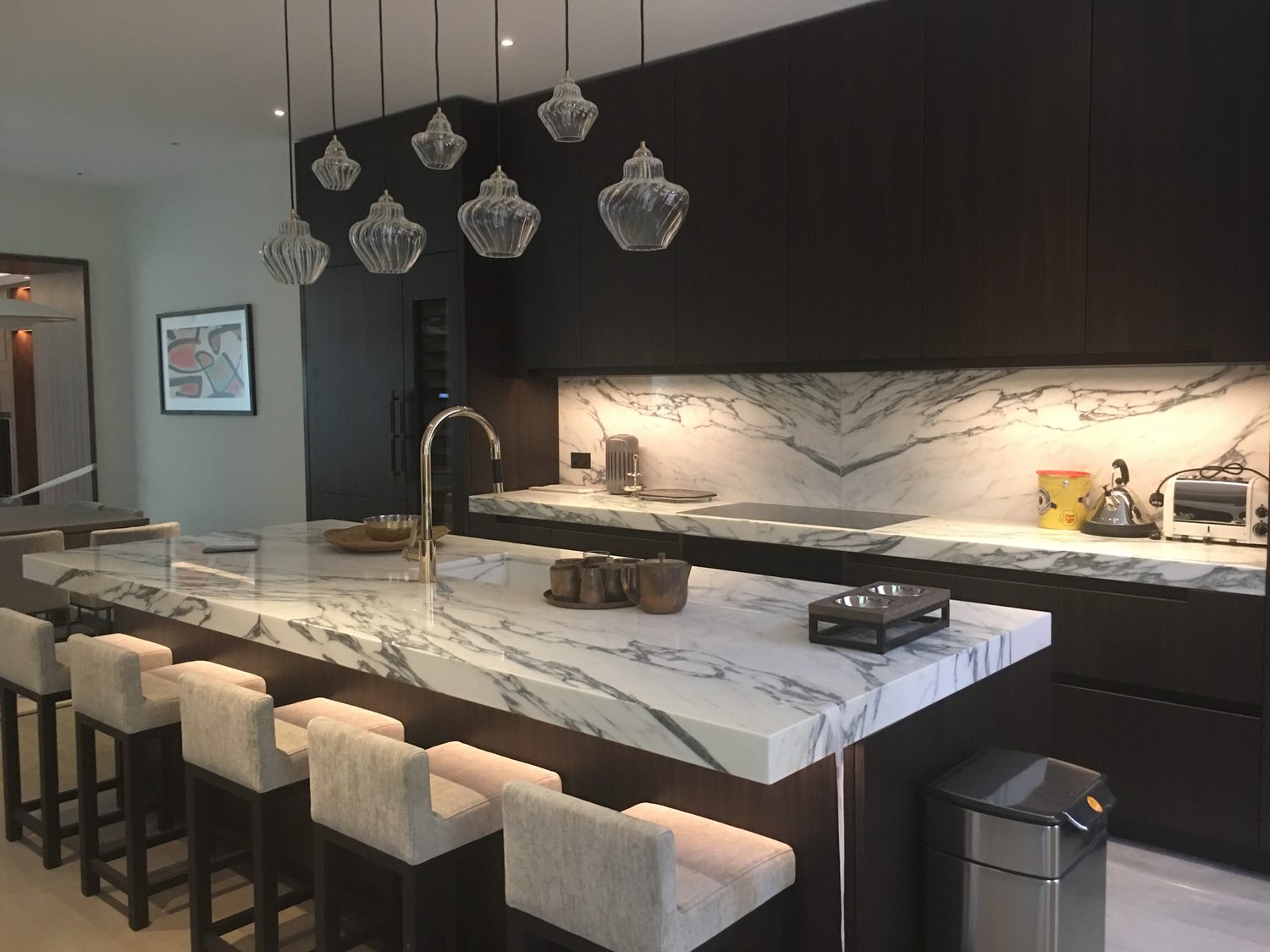
For most London kitchens we recommend quartzite. Taj Mahal, Cristallo and Bianco Eclipsia look close to marble but behave like granite: they do not etch from lemon juice or wine, and they are considerably harder. Where the look of marble matters more than the maintenance, Calacatta and Statuario remain the classic choice.
Natural stone is unique slab to slab, with veining that runs through its full thickness, which is visible on a mitred edge or a cut-out. It is porous and needs sealing. Engineered quartz is consistent, non-porous and needs no sealing, but it is less tolerant of heat because of the resin that binds it. Porcelain is non-porous, highly heat resistant and available in very large thin sheets, but its pattern is printed on the surface rather than running through the body.
Less than people expect. Engineered quartz is bound with resin, and sustained heat can discolour or mark it, so a hot pan should never go straight onto it. Porcelain handles heat far better. Granite is the most tolerant of the natural stones. We would recommend a trivet on any worktop, because thermal shock is worth avoiding on all of them.
Yes. We cut, shape and finish marble in our own workshop in North London, and have done since 1990.
Yes. Send us a drawing or a plan and we will price it properly rather than quote a rate per square metre. We aim to be competitive, and where a specification can be achieved more economically without losing quality, we will tell you.
Yes, all three. We template digitally once the units are fitted and level, fabricate in our own workshop, and install with our own teams. We do not sub-contract the installation, so the person who measured the room is accountable for the piece that arrives in it.
Yes. Off-cuts suit smaller pieces such as vanity tops, shelves, window sills and splash-backs. Availability changes constantly, so it is worth asking what is in stock when you enquire.
Yes. We supply stone floor tiles alongside worktops and larger format slabs, in the same materials we hold for fabrication.
Yes. Stone sinks are made in our workshop, usually from the same slab as the surrounding worktop so the veining runs continuously.
No. We do not recommend fitting a food waste disposal unit to a stone sink. The vibration and the fixing required are not suited to the material.
It is best avoided. A cut-out already removes material and a joint running through or beside it creates a weak point exactly where heat and weight are concentrated. Where a run is longer than the slab, we will position the joint away from cut-outs and along a vein where possible, so it reads as part of the stone.
The same applies. Joints near a sink sit in the wettest part of the kitchen and alongside a cut-out, so we design them out where the slab size allows. If one is unavoidable we will show you where it falls before anything is cut.
Square, bevelled, pencil, bullnose, ogee and several others. The edge profile has a large effect on how the finished stone reads, so it is worth deciding alongside the material rather than afterwards.
Polished gives the most depth of colour and the most reflection, and shows marks most readily. Honed is matt, softer, and hides wear far better, which is why it suits a working kitchen or a busy floor. Brushed and tumbled add texture and are the most forgiving. The same stone in four finishes gives four different rooms.
Warm water and a pH-neutral cleaner. Avoid anything acidic, and avoid limescale removers entirely, as they will etch marble and limestone on contact. Wipe spills of wine, citrus and vinegar promptly rather than leaving them to sit.
Natural stone is porous and should be sealed on installation, then resealed periodically. Sealing reduces staining from oils and pigments. It does not prevent etching from acids, which is a chemical reaction with the stone itself rather than a stain. Porcelain and engineered quartz are non-porous and need no sealing.